
ENVIRONMENTAL RESPONSIBILITY
OUR COMMITMENT TO CLIMATE RESPONSIBILITY
At the Climate Summit in Paris, governments launched a new era of global cooperation to combat climate change and protect future generations. At Biacryl, sustainability is a core value. That’s why we joined this global movement and took a hard look at our own environmental impact.
The Paris Agreement marked a historic victory for humanity, the environment, and multilateralism. It represents a “health insurance” for our planet. For the first time, every nation on Earth committed to limiting emissions, enhancing resilience, and actively fighting climate change.
Energy requirement for Biacryl:
| related to the total production in 2014 | related to standard blocks |
|---|---|
| 1.35 KWH/kg | 0.86 Kwh/kg |
We began by assessing the current energy usage across all product groups, including the types and sources of energy used. Our analysis showed that Biacryl’s process for producing standard acrylic blocks has the lowest energy consumption and CO₂ emissions in the industry.
We have committed to:
- Annually monitor and evaluate the energy performance and carbon footprint of our operations
- Identify and implement measures to reduce CO₂ emissions by an additional 15% by 2020
- Evaluate key suppliers also based on their efforts to avoid CO₂ emissions
Since 2013, Biacryl has been producing 100% CO₂-free electricity, which is fed into the Swiss national grid. The amount generated is four times the total energy consumed by our production facility in Les Verrières. Thanks to this, Biacryl has prevented 260 tons of CO₂ emissions in the past year alone — a significant contribution to a cleaner future.
When taking our CO₂-free electricity production into account as a compensatory measure, the entire production of Biacryl can be considered 100% CO₂-free. Because at Biacryl, we think not only about today, but also about tomorrow — and beyond.
IMPLEMENTED PROJECT
PV SOLAR PARK IN CH – 2126 LES VERRIERES
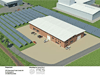
Roof System
adjustement
Roof Pitch: 8 degrees
Panel Type: Thin-film modules CX1 / CX3 by Calyxo
Inverter Configuration: 13 x Q3
Installed Power: 167 kWp
Commissioning Date: 30.09.2012
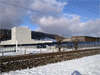
PV
solar park
Adjustment: 30° inclination
Panel Type: Thin-film CdTe modules Calyxo CX3, 80 W
Inverters: 21 x Refusol
Installed Power: 408 kWp
Commissioning Date: 30.12.2012
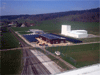
Free-standing PV power plant
Photovoltaic (PV) systems:
Roof-mounted systems
In-roof integrated systems
Free-standing (ground-mounted) installations
The total operating capacity 1 MWp